Introduction
Real-time systems are designed to react to external events within precise timing constraints. Examples include:
- Engine Controllers
- Seatbelt Monitors
Deadline Characteristics
- Periodic Tasks: Execute at regular intervals (e.g., multiple-rate periodicity).
- Aperiodic Tasks: Occur irregularly. Deadlines are classified as:
- Hard Deadlines: Missing the deadline causes system failure.
- Soft Deadlines: Missing the deadline results in degraded performance. The software architecture of such systems can adopt various strategies, including:
- Super Loop Architecture
- Foreground/Background Architecture
- Scheduling of multiple processes (Multiple scheduling policies)
Super Loop Architecture
The Super Loop Architecture is a straightforward structure where an infinite loop continuously executes tasks sequentially.
void main(void) {
    /* Initialization */
    while (1) {
        Task1();
        Task2();
        Task3();
    }
}
Key Features
- Initialization: Performed once before entering the loop.
- Task Execution: Tasks are executed sequentially within the infinite loop.
- Loop Behavior: A variant of batch processing, operating cyclically.
Challenges
- Determinism: Response time depends on the loop’s execution time, making it unpredictable.
- Responsiveness: Timely response is hard to guarantee for tasks with strict deadlines.
- Polling Periodicity: Ensuring precise timing for task execution is challenging.
- Multi-rate Systems: Handling tasks with widely varying frequencies is impractical.
Advantages
- Simple to implement.
- Minimal hardware resource requirements.
- Highly portable.
Disadvantages
- Inaccurate timing.
- High power consumption.
Flow
graph TD
    A[Initialization] --> B[Start Infinite Loop]
    B --> C[Execute Task 1]
    C --> D[Execute Task 2]
    D --> E[Execute Task N]
    E --> B
الملخص
الـ Super Loop من أبسط أنظمة البرمجة في العموم. هو برنامج فيه لوب لانهائي بتتنفذ فيه المهام المطلوبة ورا بعض.
مشكلته
- الاستجابة: لو فيه حاجة حصلت وأنت في نص مهمة تانية بيبقى صعب تستجيب سريعا.
- توقيت مهمات: مش دقيق لأن الحساب مش ثابت.
مثال بسيط
تخيل بودا في مكتب بيمر على كل درج ويفتحه يشوف فيه فلوس ولا لا. لو فلوس بياخدها ويكمل مع الباقي.
Foreground/Background Architecture
The Foreground/Background Architecture divides system operations into two levels:
- Foreground: Handles asynchronous, time-critical tasks via Interrupt Service Routines (ISRs).
- Background: Executes less critical tasks sequentially within an infinite loop.
void main(void) {
    /* Initialization */
    while (1) {
        ADC_Read();
        SPI_Read();
        USB_Packet();
    }
}

void ISR_USB(void) {
    Clear_Interrupt();
    Read_Packet();
}
Key Features
- Interrupt-Driven Foreground: Reactive tasks respond to events immediately.
- Background Tasks: Use remaining CPU cycles for non-critical operations.
Challenges
- Responsiveness: Longer interrupt latency may delay critical responses.
- Determinism: Task response times are difficult to predict due to non-uniform execution times.
- Complexity: Becomes difficult to manage for systems requiring multi-rate scheduling.
Advantages
- Faster response to critical events.
- Efficient use of CPU resources.
Disadvantages
- Increased complexity with growing task diversity.
- Longer interrupt latency for deeply nested ISRs.
Flow
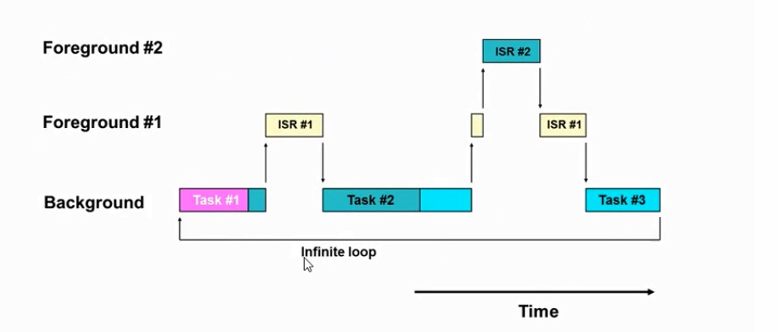
الملخص
العمل المشترك ما بين الخلفية والمقدمة في النظام ده بيعتمد على تقسيم الوظائف:
- المقدمة (الفورية): معالجة الاحداث من خلال مقاطعة الإشارات.
- الخلفية: بتشتغل في وقت فراغ المعالج لإنجاز المهام الأقل ضرورة.
مثال بسيط
تخيل بودا بواب بيفتح البوابة كل ما يسمع الجرس (المقدمة) ويسرق في الوقت الفاضي (الخلفية).
Multi-Rate Systems
Multi-Rate Systems manage tasks with varying timing requirements, including synchronous and asynchronous tasks.
Key Characteristics
- Synchronous Periodic Tasks: Repeat at different rates (e.g., spark control every 2 ms).
- Aperiodic Tasks: Triggered by irregular events (e.g., button press).
- Modern Applications: Common in systems like automobile engine controllers.
Challenges
- Keeping track of both synchronous and asynchronous tasks.
- Applying different timing requirements to each task type.
- Major limitations of Super Loop and Foreground/Background Architectures in handling multi-rate systems effectively.
الملخص
في أنظمة المعالجة متعددة السرعات:
- المهام الدورية: بتتنفذ في مواعيد محددة ومختلفة في نفس الوقت.
- المهام غير الدورية: بتحصل غير منظمة ولازم تعامل مختلف مع متطلباتها.
مثال بسيط
تخيل بودا بيسرق كل 2 ثانية ويتوب كل 1000 ثانية. كل مهمة لها توقيتها والنظام يعتمد على التنسيق بين هذه المهام.
مقارنة سريعه
| النوع | المميزات | العيوب |
|---|---|---|
| Super Loop | بسيط وسهل التنفيذ. | غير دقيق في التوقيت. |
| لا يحتاج موارد كبيرة. | صعوبة في التعامل مع المهام متعددة السرعات (Multi-rate). | |
| سهل النقل بين الأنظمة. | استجابة بطيئة للأحداث الطارئة. | |
| Foreground/Background | استجابة أسرع للأحداث الحرجة من خلال الانتربت (Interrupts). | تعقيد أكبر مع زيادة عدد المهام. |
| استغلال فعال لقدرات المعالج. | زمن تأخير الانتربت قد يؤخر المهام الحرجة. | |
| تحديات في التحكم في الأنظمة متعددة السرعات. | ||
| Multi-Rate Systems | يمكنه التعامل مع المهام الدورية وغير الدورية بمواقيت مختلفة. | يتطلب تنسيق معقد بين المهام المختلفة. |
| مناسب للتطبيقات الحديثة مثل أنظمة السيارات. | صعب التنفيذ باستخدام Super Loop أو Foreground/Background. |
ملخص بسيط
- Super Loop: مناسب لو المهام بسيطة ومش محتاجة توقيت دقيق، لكن استجابته بطيئة ومش هينفع مع الأنظمة المعقدة.
- Foreground/Background: أحسن في التعامل مع الأحداث الفورية لكنه معقد شوية وصعب يظبط توقيت المهام المتعددة.
- Multi-Rate Systems: أحسن حاجة للأنظمة الحديثة والمعقدة زي أنظمة السيارات، بس محتاج نظام إدارة قوي ومناسب ليه.