Neural Networks
Origins
- Neural networks (NNs) are algorithms designed to mimic the brain.
- Popular in the 1980s and early 1990s, but popularity waned in the late 1990s.
- Recent resurgence as a state-of-the-art technique in various applications.
- Artificial neural networks are far simpler than the brain’s structure.
The Brain
- Composition: Networks of neurons.
- Function: Brain activity occurs due to neuron firing.
- Neurons:
- Connect through synapses, propagating action potentials (electrical impulses).
- Synapses release neurotransmitters, which can be:
- Excitatory: Increase potential.
- Inhibitory: Decrease potential.
- Learning: Synapses exhibit plasticity, enabling long-term changes in connection strength.
- Scale:
- ~10¹¹ neurons.
- ~10¹⁴ synapses.
Neural Networks and the Brain
- Neural networks consist of computational models of neurons called perceptrons.
The Perceptron
- A threshold unit:
- Fires if the weighted sum of inputs exceeds a threshold.
- Analogous to a threshold gate in Boolean circuits.
graph TD
    Input1 -->|Weight1| Perceptron
    Input2 -->|Weight2| Perceptron
    Perceptron --> Output
Soft Perceptron (Logistic)
- Replaces threshold with a sigmoid activation function.
- A “squashing” function that produces a continuous output.
Structure of Neural Networks
- Composed of nodes (units) connected by links.
- Each link has a weight and activation level.
- Each node has:
- Input function: Summing weighted inputs.
- Activation function: Transforms the input value.
- Output.
Multi-Layer Perceptron
- Feed-Forward Process:
- Input layer units are activated by external stimuli (e.g., sensors).
- The input function computes input values by summing weighted activations.
- Activation function applies a non-linear transformation (e.g., sigmoid).
- Inputs: Real or Boolean.
- Outputs: Real or Boolean; can have multiple outputs per input.
graph LR
    Input1 --> Hidden1
    Input2 --> Hidden1
    Hidden1 --> Output
    Hidden1 --> Hidden2
    Hidden2 --> Output
Summary
- Neural networks are inspired by biological neurons but are far less complex.
- Their structure and functionality involve input, activation, and output, mimicking a simplified version of brain processes.
- Feed-forward networks like multi-layer perceptrons are foundational to many applications.
Slides Ex.2
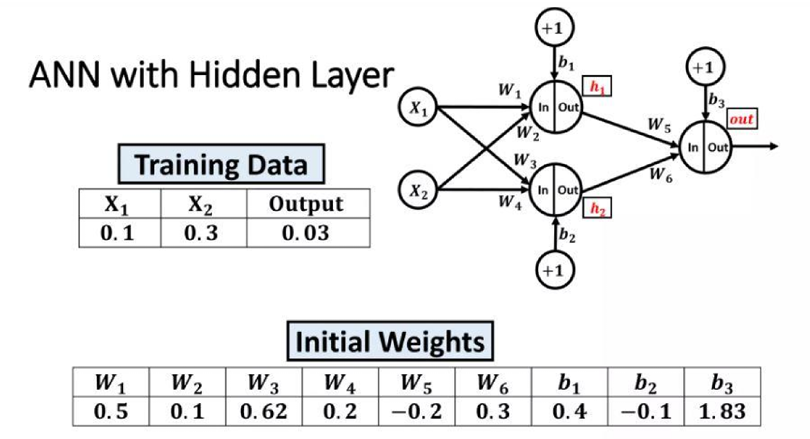
Error Function:
1. Gradients for Output Layer Weights ():
Let’s first compute the error gradient for :
Step 1: Compute :
Step 2: Derivative of output activation:
For sigmoid:
\large out = f(z) = \frac{1}{1 + e^{-z}}$$$$\large f'(z) = out(1 - out)
Step 3: Chain rule application:
For :
Now substituting values:
Similarly, for :
2. Gradients for Hidden Layer Weights ():
For (connected to ):
We need to backpropagate through :
Breaking it down:
- From earlier:
- From hidden layer :
- Weight contribution:
Combining:
Similarly, for :
3. Final Gradient Formulas:
- Output Layer:
\large \frac{\partial E}{\partial W_5} = -(y - out)(out)(1 - out)(h_1)$$$$\large \frac{\partial E}{\partial W_6} = -(y - out)(out)(1 - out)(h_2)
- Hidden Layer:
\large \frac{\partial E}{\partial W_1} = -(y - out)(out)(1 - out)(W_5)(h_1)(1 - h_1)(X_1)$$$$\large \frac{\partial E}{\partial W_2} = -(y - out)(out)(1 - out)(W_5)(h_1)(1 - h_1)(X_2)$$$$\large \frac{\partial E}{\partial W_3} = -(y - out)(out)(1 - out)(W_6)(h_2)(1 - h_2)(X_1)$$$$\large \frac{\partial E}{\partial W_4} = -(y - out)(out)(1 - out)(W_6)(h_2)(1 - h_2)(X_2)